
-Compiled and edited by J. Spencer.
(This article appeared in the 2012 Winter Gilders Tip)
A few years ago, the price of gold leaf was affected much more by the cost of manufacturing; now the scale has tipped, and the cost of gold is some ⅔ of the price of leaf. Though it changes depending on many factors, the price of gold itself is fairly constant the world over; so among different leafs the main price differences lie first in manufacturing costs, and second, in the actual amount of gold used. Suppliers’ prices also vary, for the usual reasons – volume, levels of service, location, etc. But we are concerned here with the quality characteristics of gold leaf rather than its price – in other words, not what you’re paying, but what you’re paying for. In comparing different leafs there are many qualities to consider besides the price of a book.
We set out to find whether leaf size or availability was diminishing in today’s market. Actually, we found the reverse to be true. Traditionally, American leaf was made 3⅜ in. (86 mm) square; European leaf was 3⅛ in. (80 mm). Although some suppliers have shifted toward the European size, both sizes are still readily available. We found 3⅜ in. leaf made by Manetti (who also makes European-size leaf), Monastery (a Chinese brand), and American maker W&B Gold Leaf. (Gold Leaf Products used to make 3⅜ in., but has switched to 3⅛ in.)1
Besides that produced here, most of the gold on the American market is made in Germany, Italy, and China. Leaf is also made in Russia, Japan, and Australia, among others, but primarily for their own domestic markets. Thai gold in 1⅜ in. (35mm) leaves has recently come on the market (much of it sold through eBay, though Gold Leaf Products, whose leaf is made in Thailand, also offers the traditional Thai size).2 These small leaves, originally made for ceremonial application to temple figures, are now being marketed for art & craft use here.
Gold leaf used to be primarily a “to-the-trade-only” material, but is now available from many retail art & craft supply stores. The downside to the (mostly online) proliferation of suppliers and products is that, though there may be more choices available, there is often little information to help with those choices. We found a great deal of variation in the ways gold was described by suppliers. Some note its exact composition, size, karat rating, weight and manufacturer; others just say “23kt,” and leave us to guess its size. Detailed specification may not always be important to you, but it’s good to know someone who can supply that information should you need it. It’s also helpful to know what those details tell you.
Gold Leaf Specifications
Purity: in karats, with 24kt being nearly pure gold. Gold leaf is available in 24kt, but is usually an alloy consisting primarily of gold, with additions of copper, silver, or palladium.
Thickness: in microns (millionths of a meter, also called micrometers, abbr. μ). It’s impossible to make gold leaf perfectly uniform; it’s so thin that tiny variations are proportionally large. A typical range of thickness for American and European leaf is .3 –.6μ, averaging about .4μ. (For comparison, a typical human hair at .003 in. is about 150 times as thick.) The Chinese leaf we were able to find specifications for was described as .1 –.2μ thick.
Weight: in grams per 1000 leaves (two packs); usually based on a 3⅜ in. leaf size (but check to make sure if you’re buying a different size). This reflects both the thickness of the leaf and the purity of the gold (gold being heavier than added metals).
Color: reflects the composition of the leaf. The color designations below are descriptive terms used by many suppliers, not “brand name” colors. Typical weights for different colors range from 13–19 gm/1000 leaves; actual gold weights depend on karat value.
- 24kt Finegold
- Rosenoble: a deep-colored 23.75kt gold
- Red gold: gold mixed only with copper, giving it a red cast
- 23kt: not usually given a descriptive name, being pretty much the standard color
- Lemon gold: a cool yellow 18–22kt gold, usually mixed only with silver
- Green gold: similar to lemon gold but with a greener cast and some copper content
- Pale gold: pale silvery yellow between lemon and white gold, usually 14-16kt.
- White gold: from 6–13.5kt — that is, ¼ to just over ½ gold, the balance being silver. Higher-karat white gold has a slight gold cast; lower karat (sometimes called “gray gold”) looks like silver.
- Moon gold: a deep champagne color produced by mixing palladium and silver with gold.
- Palladium and platinum: similar silver-colored, non-tarnishing3 precious metals. Both are used in (especially exterior) applications where real silver would degrade quickly.
There are other colors, many of them slight variations on the above, as well as propriety colors (e.g., Dauvet’s “Versailles”) and dyed Japanese leaf in many colors. Most suppliers offer color cards of actual leaf samples; prices vary, depending primarily on the number of colors offered.

Types of Gold
Surface: single weight, standard quality leaf, suitable for use on surfaces (e.g., frames, panels, etc.).
Glass: so called because it is more regular (not thicker) than surface gold, so is suitable for use on glass, where flaws would show more. It typically costs only slightly more than surface gold of the same weight.
Double: heavier than single weight, but typically only by a few grams/1000. For example, if single weight is 16 gms/1000, double might be 18. “XX” and “XXX” are remnants of past terminology; they imply extra weight or quality, but no longer have any specific meaning.
Edible gold (or silver): certified “edible” at the factory; available as flakes, ribbons and leaves, in food-grade packaging.
Packaging
Book: tissue paper book with 25 gold leaves hand-placed between the pages (some suppliers also offer 5- or 7-sheet mini-books). The leaf may be loose for application with a tip; patent or transfer leaf is adhered lightly to the pages, so it can be applied by hand, used outdoors without blowing away, or transferred to a small pattern without wasting leaf. Loose leaf may be used with any mordant; patent is not suitable for water gilding.
Box or pack: 500 leaves (20 books of 25 leaves)
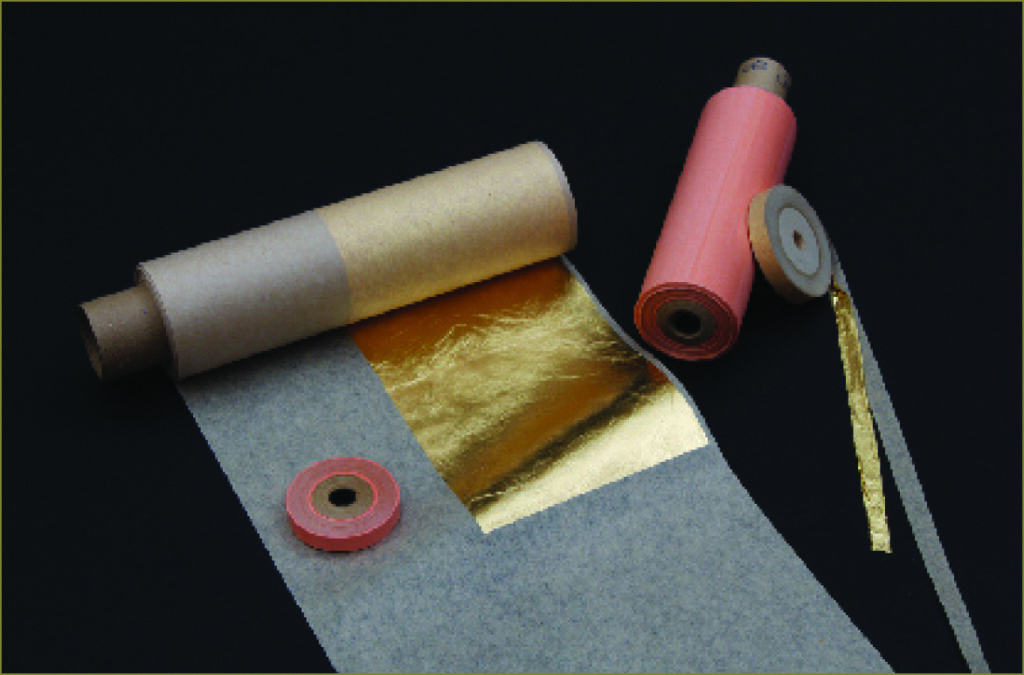
Roll leaf or ribbon leaf (4⅛–6 in. wide by 20 meters), for use on large flat areas (or slit into narrower widths for striping, etc.); comes in the standard colors of gold. Suppliers usually offer a number of standard widths; many will provide custom widths.
Leaf Quality and Working Qualities
Neither higher price nor thicker leaf necessarily equates to better quality; however, as a practical matter, the cheapest leaf on the market today is both very thin and of lesser quality. Aside from simply using less gold by beating the leaf thinner, there are many other ways manufacturers can cut corners to lower costs, including skimping on worker training and hurrying the manufacturing process.
Alloying or annealing may be done improperly before beating. Gold that is Inadequately-prepared and/or beaten too quickly becomes work-hardened; the resulting leaf has been described as having a dry, “crackly” feel, compared to the “soft” or “flowing” character of higher-quality leaf. This brittle leaf does not lay down as well; and tears easily. Poor-quality papers used in beating can give either a hard, overly shiny or dull surface; the leaf, rather than the gilder, will dictate the look of the work.
These practices also produce leaf with more flaws — pin holes, “worm tracks” (small wiggly voids in the leaf), “lightning bolts” (jagged lines with a different sheen or color), tears or incomplete leaves. (Manufacturers of higher-quality leaf would reject such damaged leaves.)
Careless booking can cause waste when leaf is bunched up, folded or placed too far into the book binding; poorly-cut leaf can be off-square, or may be double-cut. Too little rouge will cause the leaves to stick in the book, causing damage when they are removed. Low-quality paper can also cause sticking; excess rouge, often used to remedy this, can keep leaf from adhering properly to the size, and may discolor the work. Poor paper may also have a rough or grained surface that can transfer to the leaf. (Again, the leaf ends up dictating the look.)
Certainly, not all gilding requires the highest-quality leaf. If you are using small bits of leaf, using patent leaf on small areas, or making heavily-toned or distressed pieces, leaf with flaws or even tears may be acceptable. However, burnished water gilding requires leaf that handles well in loose form and burnishes consistently; exterior gilding requires leaf that is thick and regular enough to withstand the wear it will be subject to.
Learning to judge the quality of leaf required by the job,4 and to distinguish different qualities of leaf, are important steps to achieving consistent quality in gilding. We hope this will shed some light on the working qualities of different leafs, and help you to evaluate both the leaf you find for sale and the suppliers who offer it.
Footnotes:
1. 2 in. (50 mm), 3 ½ in. (90 mm), and 4⅛ in. “large area” leaf are also made, but are not as widely available.
2. One intriguing Thai product is offered as “gold on base;” as far as we could tell, the gold is deposited on a thin sheet of resin.
3. In most environments; however, palladium is susceptible to chlorine, so don’t use it by the pool or a chlorinated fountain!
4. A supplier who is familiar with gilding can be very helpful with this.
Thanks to Sepp Leaf, Easy Leaf and W&B Gold Leaf for their information on gold and metal leaf standards, specifications and manufacture.
Do the Math
Compare prices of different-sized leafs: on the Coverage Areas table, find the number of square feet covered for each size and “format” of gold you’re comparing. Divide each one’s square footage into its price per unit (book, box, etc.); the result will be its price per square foot. (Be sure you’re comparing the same number of leaves for each size.)
Compare grams/1000 leaves of different-sized leafs: To compare to 3⅜ leaves: for 3⅛ in., multiply by 1.16; for 1⅜ in., multiply by 5.97.
Ouch: If the mixture of English and metric measurements makes your head explode, a good online measurement converter can be found at http://www.convert-me.com/en/. It not only converts English to metric and vice versa, but also includes a number of more arcane international measurements.
Leaf Coverage (in sq. ft)
Waste / overlap not considered in calculating coverage.
| Material | Size | Qty. | Sq. Ft |
| Thai Gold Leaf | 1⅜ in x 1⅜ in | 25 | .33 |
| Thai Gold Leaf | 1⅜ in x 1⅜ in | 500 | 6.56 |
| Gold Leaf – Book | 3⅛ in x 3⅛ in | 25 | 1.69 |
| Gold Leaf – Book | 3⅜ in x 3⅜ in | 25 | 1.97 |
| Gold Leaf – Pack | 3⅛ in x 3⅛ in | 500 | 33.90 |
| Gold Leaf – Pack | 3⅜ in x 3⅜ in | 500 | 39.50 |
| Japanese Leaf | 45/16 in x 45/16 in | 500 | 64.60 |
| Manetti – Italian Gold Roll | 4⅛ x 67 ft | Master Roll | 22.00 |
| Manetti – Italian Palladium Roll | 3⅜ in x 67 ft | Master Roll | 18.80 |
| Crocodile – German Gold Roll | 4⅛ x 69 ft | Master Roll | 23.50 |
| Italian Silver Master Roll | 5½ in x 82 ft | Master Roll | 37.50 |
Thanks to Easy Leaf Products, Sepp Leaf, and W&B Gold Leaf for their information on gold and metal leaf standards, specifications and manufacture.
